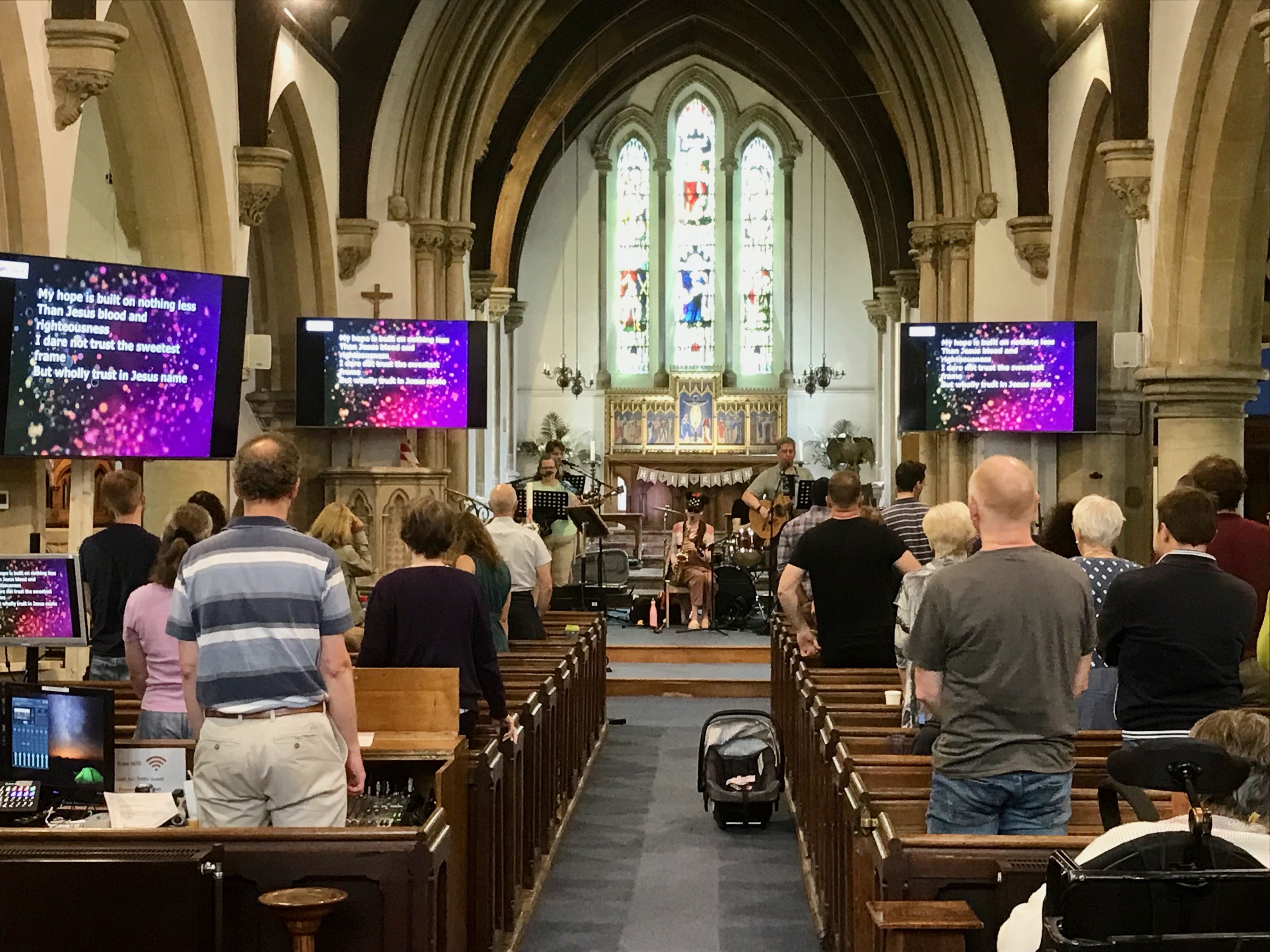
 Picture by Lorna Minton
St Mary the Virgin, Twyford, which until 1876 was part of the church parish of Hurst, was built in 1846. During the mid-19th century the Great Western Railway built the line from Paddington to Bristol, including the branch to Henley-on Thames, and Twyford began to expand. The North aisle of the church was added in 1883; it was further enlarged in 1908 and 1910. This church provided for those who lived in Twyford.
The church was reordered in 1993 and a new building added on to the south side of the nave comprising a hall, kitchen, toilets, offices and a lounge type meeting room (the Stephenson Room). Together they form St Mary's Church Centre.
St Mary's Church and the ground floor of the Centre are both accessible to those in wheelcharis. There are toilet facilities for the disabled.
A more detailed history of St Mary's
Until the middle of the 19th Century, the religious needs of Twyford were served in part by Ruscombe Church and also by the Chapel of Polehampton School which was generously provided by Edward Polehampton of the City of London. The Chapel, which was never dedicated, was opened on 15 September 1728 and served as a Church for the hamlet until 1847. It was demolished in 1888. Twyford was part of the Parish of Hurst and the Chapel was served by the Vicars and Curates of that parish.
As the population of Twyford grew, the need for a church became pressing. The land on which St Mary's stands was given by Robert Palmer (of Huntley and Palmer biscuits) who lived at Holme Park, Sonning; and he laid the foundation stone on 25 March 1846. The new building, then a Chapel-of-Ease, was consecrated on 26 May 1847 by Bishop Wilberforce of Oxford. It remained part of the parish of Hurst and was serviced by its clergy.
The building was designed by Benjamin Ferrey in the early English style and comprised a nave, chancel, south aisle (with lean-to roof), small vestry and oak porch.
Twyford became a separate parish on 14 April 1876 and the Revd Edward Gleadow Wilkinson, then the Curate at Hurst, became the first vicar.
At a public meeting in 1882 the feasibility of enlarging the church to meet the needs of the growing population was considered and agreed. The plan was to take down the North wall, 'stone by stone, window by window' and build a series of arches, matching those on the south aisle, to support the nave roof. The stones and windows would be replaced to form the outer wall of the north aisle. A choir vestry was also added at this time and both were dedicated by Bishop Mackarness on 16 October 1883.
The Revd Robert William Harrison Acworth had become the second vicar in 1903. During the immediate years the growth in population continued to drive the need for even more seats and facilities, and under the new vicar the period 1908 to 1910 saw a great deal of change to the church building. An organ chamber was built in remembrance of the Vicar's mother. The chancel was extended by 13 ft eastwards and the three half lancet windows, with the rose window above, were replaced with three full length lancets. At the west end, the nave was extended some 20 ft and, in the south west comer, incorporated a baptistery with tower above. Initially there were insufficient funds to complete the tower, but an appeal for the final £600 was successful and the 65 ft tower was completed in 1910.
On 13 October 1910, Francis, Bishop of Oxford, dedicated the tower and baptistery; the enlargement of the nave and chancel; the bellcote and bell which now stand over the chancel arch; a cover for the font, the screen between the nave and organ, a Litany desk and a brass tablet placed next to the oak screen commemorating Edward Gleadow Wilkinson, the first vicar of this church.
The Tower was constructed to hold a 'Peal of Eight Bells' but there was insufficient money left over from the building works to install at the time. The Revd Acworth started another Appeal which raised £711.11.0 and the 'Peal of Bells' was dedicated on Easter Tuesday 1913 by the Archdeacon of Berkshire.
In 1919 the plain East window was replaced by stained glass. The Reredos behind the High Altar was dedicated on 20 May 1928 by the Bishop of Buckingham.
Electricity replaced gas in the church in 1928 and with its introduction came a new Electric Organ built by Messrs Bishop and Sons and installed in 1932. It is said to be one of only two ever made. The console for the new organ was placed in the choir vestry but all the working parts were housed in the organ chamber on the opposite side of the chancel. The organ had three manuals and a complete pedal organ. The organ was no longer playable and was removed in 2001. On 1 June 1932 the Right Revd Bishop Shaw consecrated the Lady Chapel, situated in the North Transept, and dedicated the new organ.
From 1931 the Parish shared a vicar with St James, Ruscombe, but it was not until 1973 that the two parishes became one.
On 22 May 1994 the whole Congregation of Ruscombe and Twyford (Ecclesiastical) Parish jointly opened St Mary's Church Centre - the new hall attached to the Church providing many new facilities for the church and the local community including a Parish Office, meeting room, hall, kitchen and toilets. Above all it provided the opportunity to integrate the Sunday School children more fully into the life of the Church.
 Join us at St James' for a traditional style service with a warm welcome.
 Join us at Twyford URC for a friendly service with a mix of modern and traditional styles.
 St James is situated in the heart of the Ruscombe Conservation Area. With a seating capacity of 80, it is used regularly for smaller Sunday services and Baptisms, while larger events and services take place at St Mary's, Twyford.
 hen within the parish of Sonning, was first mentioned. It seems probable therefore that this chapel at Ruscombe was built sometime between 1091 and 1185. The chancel walls of the present church are the original walls, with the original lancet windows in the east and north walls. The window on the south wall of the chancel has subsequently been enlarged to let in more light.
 The present nave and tower date from 1638/9. On the walls are several monumental tablets of the 17th to 20th centuries to the memory of local families, the Allworths, Nevilles and Barkers. The most impressive of these is located on the north wall of the nave, in memory of Sir James Eyre, Lord Chief Justice of the Court of Common Pleas who died in 1799. The inscriptions indicate that people were buried under the floor of the chancel. This was confirmed during the course of essential repairs to the subsiding chancel floor in 1992, when 13 lead linings of coffins were discovered, along with corroded coffin handles, plates and nails, and a considerable quantity of human remains.
 Twyford URC was founded in 1796, as a result of evangelism in villages around Reading, by the Minister and Members of former Broad Street Congregational Church (now Waterstones) in Reading. The current Church was built in 1897 and the hall in 1935, with extensions in the 1960s and 1970s.